Sigma 19mm F28 Ex Dn Art Emount Lens for Sony Black
2 wide-angle primes Sony APS-C Due east-mount users will be familiar with are the Sigma 19mm f/2.8 DN Art and the Sony East 20mm f/2.viii. Both offer an angle of view that isn't far off the 28mm equivalent, making them a popular choice amongst photographers who more often than not shoot street with broad bending lenses, besides as those who enjoy landscape and cityscapes.
Because the 2 lenses are very similar on paper, we decided to conduct this side-by-side comparison to see how they actually perform out in the field on our a6300. We promise it helps y'all come up to a decision well-nigh which 1 to purchase!
Ethics statement: We bought the Sony 20mm f/2.viii for our own personal use whereas the Sigma 19mm f/2.viii was loaned to u.s. for ii weeks. We were not asked to write anything almost these products, nor were we provided with whatsoever sort of bounty. Within the article, there are chapter links. If you buy something later clicking the link, we will receive a pocket-sized commission. To know more about our ethics, yous tin can visit our total disclosure folio. Thank you!
[toc heading_levels="2″]
Primary Specifications
Sigma 19mm f/2.8 DN Art
- Mount: Sony E-mountain
- Format: APS-C
- Focal length: 19mm (28.5mm in 35mm equivalent terms)
- Lens configuration: 8 elements in vi groups
- Lens coating: Super Multi-Layer Coating
- Bending of view: 59.iii°
- Minimum focusing distance: 20cm
- Magnification: 0.135x
- Aperture blades: 7 circular blades
- Aperture range: 2.8 to 22
- Filter bore: 46mm
- Weather-sealing: N/A
- Optical stabilisation: N/A
- Dimensions: 60.8 x 45.7mm
- Weight: 150g
Sony E 20mm f/two.eight
- Mount: Sony Due east-mount
- Format: APS-C
- Focal length: 20mm (30mm in 35mm equivalent terms)
- Lens configuration: 6 elements in vi groups
- Lens coating: N/A
- Bending of view: 70°
- Minimum focusing distance: 20cm
- Magnification: 0.12x
- Discontinuity blades: seven circular blades
- Discontinuity range: 2.8 to xvi
- Filter diameter:49mm
- Weather condition-sealing: N/A
- Optical stabilisation: Northward/A
- Dimensions: 62.vi x xx.4mm
- Weight: 69g
Design and ease of use
Despite having more than or less the same circumference, the Sigma 19mm is approximately twice the height and weight of the Sony 20mm pancake lens. That being said, both lenses are very light and compact and accommodate all cameras in the a5000/a6000 serial perfectly.
The Sigma is generally made of loftier quality plastics with a brass bayonet mount whereas the latter has an aluminium shell with a moulded plastic interior and a metallic mount. Sadly neither lens features weatherproofing, so take care when using them outdoors in inclement weather condition.
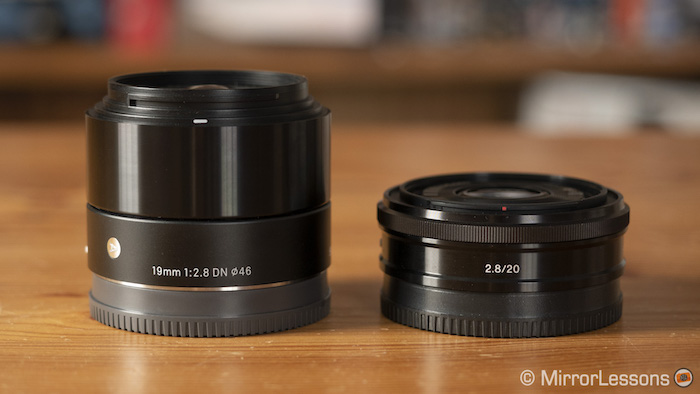
In terms of physical features, in that location isn't all that much to talk well-nigh. Both accept a fly-by-wire focus ring just that of the Sony is thin and ridged while the Sigma's is fairly large and shine. Other features they have in common are a filter thread, prune-on lens cap and twist-on lens plastic hood. Somewhat annoyingly, you can't attach the hood and cap to the Sony lens at the same time.
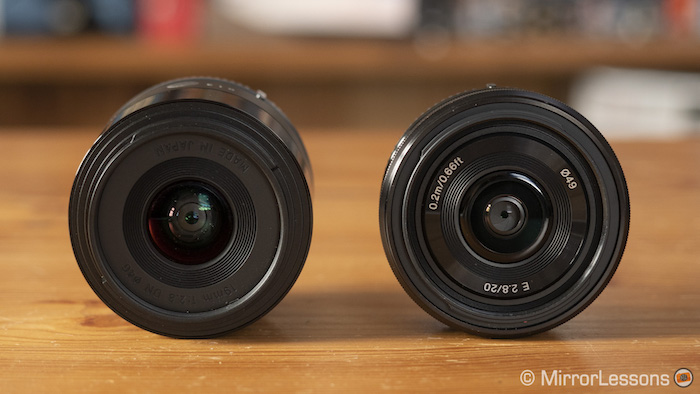
The two lenses use different motor types – a stepper motor on the Sony and a linear AF motor on the Sigma – only both are capable of precise and placidity autofocusing.
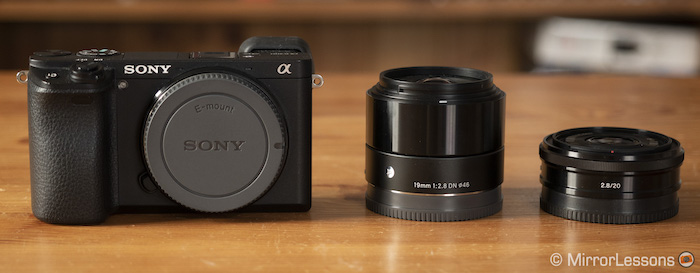
The samples you see hither both have a black finish just for those who ain a silver APS-C body, it's worth keeping in mind that there is also a silver version of the Sigma lens.
Optical quality – Through the lens
Of import notation: Sony RAW files aren't automatically corrected when you import them into an imaging software such as Adobe Lightroom. To obtain the best results, you accept to employ the correct lens profile in the Lens Corrections section, which is what I've done for all the images in this section. If you mostly employ SOOC JPGs, you can gear up the lens corrections (shading, chromatic aberration and distortion) in the Lens Comp. menu to Auto.
Sharpness
Kickoff let'due south take a look at the sharpness of these two lenses taken at a distance of around 5m.
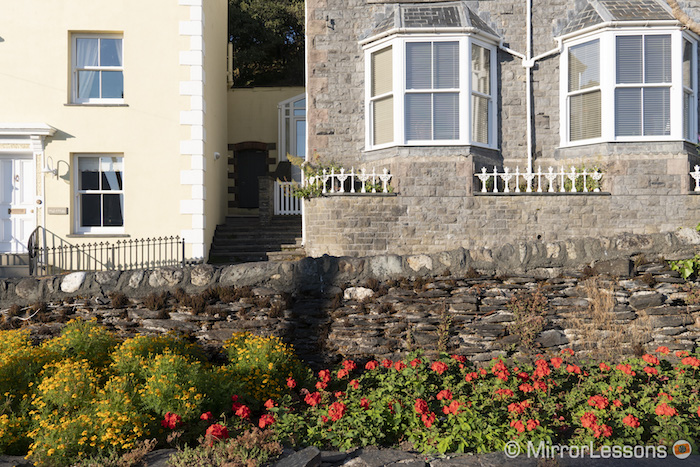
At the center, you'll detect that the Sigma 19mm is visibly sharper than the Sony 20mm at their shared fastest discontinuity of f/ii.8.

Once you lot stop downwards to f/4 and f/v.6 all the same, the differences are so pocket-sized that it becomes difficult to tell the two lenses autonomously. That said, I would still say the Sigma retains a very small advantage over the Sony. These are also the values at which both lenses display the all-time performance.


Both lenses commencement to lose some sharpness from f/viii onwards but just become unusably soft at f/16. Once again, information technology is very difficult to tell the two apart if nosotros look at sharpness lonely.


Turning to the corner performance, there are even fewer differences to mention. Perhaps the only thing worth pointing out is that the Sony – in the absolute extreme corners – is softer than the Sigma up until f/viii. Below you can see some examples taken at f/2.viii, f/v.6 and f/11.


Height performance is found at around f/5.6 in the case of both lenses but all values upward to f/11 are fairly good.
Bokeh / Minimum focus distance
Few people would buy a wide-angle prime number primarily for its bokeh qualities but since both the Sigma 19mm and Sony 20mm share a reasonably fast maximum discontinuity of f/2.8, it's worth taking a quick look at how the background blur compares.


As yous tin can see from the 2 examples above, the rendering is extremely similar with the exception of the bokeh balls which are rounder in images taken with the Sony lens. I wouldn't call the bokeh particularly pleasant but if you use the lenses at their shared minimum focus altitude of 20cm, you lot can go decent results.


Flare
Although the Sigma benefits from Super Multi-Layer Blanket to reduce flare and ghosting, we found in our tests that the 2 lenses actually perform in a very similar manner in terms of flare resistance. If the sunday is in your frame, you lot can await a dark-green orb of some shape or grade to announced in your image equally you can see in the examples below.


If the low-cal source is outside your frame, you should take fewer bug with flare if you lot attach the provided lens hoods.
Chromatic aberration
Both lenses suffer from some lateral chromatic aberration in areas of high dissimilarity but in the case of the Sigma, it is much more notable even at f/5.6. With the Sony, it usually disappears past f/iv. Equally always, y'all can clean it upwards quite nicely in mail-production software applications such as Lightroom, and then I don't consider it a huge concern.




Baloney and Vignetting
As with any wide-bending lens, moderate barrel baloney is a given. If you make sure to apply the correct lens profile either in-camera or in a mail-production software to the two lenses, information technology shouldn't pose a problem in whatsoever of your images. Beneath y'all can encounter the difference betwixt images that have been corrected with the contour and those that accept not.




Happily neither lens shows any stiff vignetting – not even at f/2.8 – so that's i less thing to worry nigh!
Field of view
The difference in field of view is exactly what you'd await from these two lenses: the Sigma is marginally wider than the Sony just not so much that it would make a large deviation to how or what you shoot. You can meet the deviation past toggling back and along between the two images below.


Autofocus performance
To test the autofocus of the two lenses, I used the Sony a6300. It has a hybrid autofocus system which comprises 425 phase detection AF (PDAF) points and 169 contrast detection points.
There is very niggling to say against the autofocus mechanism of the Sony lens. Despite being a adequately one-time production, information technology is quick in skilful light in both single AF and continuous AF, especially when combined with the stage detection autofocus system (PDAF) of the latest Sony bodies, and only slows down a little in poor low-cal atmospheric condition or scenes with trivial contrast.
The Sigma, on the other paw, is fast in Southward-AF way only somewhat more than sluggish in C-AF considering the PDAF squares simply piece of work at the very centre in Broad, Zone or Expand Flexible Spot mode. In any of the other modes and anywhere else beyond the frame, the lens relies on dissimilarity detection autofocus. That said, the 19mm is a wide angle lens, and so yous'll rarely need information technology for moving subjects anyhow.
The AF machinery of both lenses is very repose, making them useful for stills and video work.
Manual focusing
The fly-past-wire manual focusing experience of both lenses is fine just between the two, we tend to prefer the Sony's focus band because it has a ribbed design that's easier to take hold of onto.
The time it takes to travel from infinity to the minimum focus distance on the Sony depends on the speed at which you plough the ring: turning information technology quickly takes 1/four of a plough whereas turning it slowly requires virtually 3/4 of a plow. The Sigma requires a 3/4 turn regardless of how fast or slow you turn the band.
Conclusion
Unlike some other lenses I've compared, I find that overall the Sony 19mm and Sony 20mm provide a very similar user experience, and so much that I'd sometimes even forgot that I was using one instead of the other. Aye, the Sony is physically a smaller lens to be sure, merely you don't actually perceive the added weight of the Sigma once it's attached to the camera body.
The only existent difference that could accept an impact on your decision is the price. As of today, a make new copy of the Sigma 19mm will set up you dorsum approximately $170, which is a steal considering that the Sony 20mm is around twice the cost. Factor into this the fact that the Sigma is sharper than the Sony at f/2.8 and in the corners, and it soon becomes clear which is the ameliorate deal.
The sole reward the Sony retains over the Sigma is its compatibility with PDAF but since we are dealing with wide-bending lenses, there isn't much to be gained from having fast C-AF operation unless you demand information technology for specific activeness shots.
Choose the Sigma 19mm f/2.8 if you:
- want to spend as little equally possible on a broad-bending lens for your Sony APS-C camera
- want the best sharpness
- don't intendance about phase detection AF
Choose the Sony 20mm f/2.8 if you lot:
- want the most compact wide-angle lens possible
- feel you lot might demand stage detection AF for some reason
Check the price of the Sigma 19mm f/ii.8 on
Amazon | Amazon Uk | B&H Photograph | eBay
Check the price of the Sony 20mm f/2.viii on
Amazon | Amazon United kingdom | eBay
You may also exist interested in:
- Samyang Rokinon 50mm AF vs. Sony FE 55mm f/i.viii
- Sony 35mm f/1.viii vs Sigma 30mm f/1.iv vs Sigma 30mm f/two.viii
- Sigma 16mm f/1.4 vs Sony 16mm f/two.8
- Sony 35mm f/1.8 vs 50mm f/1.viii
Sample Images
Sigma 19mm f/2.eight DN Art


Sony Eastward 20mm f/2.8


Source: https://mirrorlesscomparison.com/e-mount-lenses/sigma-19mm-2-8-vs-sony-20mm-2-8/
0 Response to "Sigma 19mm F28 Ex Dn Art Emount Lens for Sony Black"
Post a Comment